
How to Teach Grammar the Charlotte Mason Way: A Gentle Guide
Grammar is one of those subjects I’ve always preferred to keep simple in our homeschool. After years of homeschooling children at different ages and stages, I’ve grown to appreciate the gentle, thoughtful way Charlotte Mason approached teaching grammar.
One of the things I love most about her approach is how naturally grammar builds on the good books and beautiful language our children have already grown familiar with.
If you’ve been wondering how to teach grammar the Charlotte Mason way, I’d love to share some simple ways to approach it in your own homeschool.
This post may contain carefully chosen affiliate links to help support our homeschooling journey. Thank you for supporting my family through your purchases! You can read my full affiliate disclosure policy here.
A Gentle Approach to Charlotte Mason Grammar
Charlotte Mason believed that children should first become familiar with good language before beginning the formal study of grammar. Through living books, poetry, narration, and copywork, they gradually develop an understanding of how words and sentences work together.
Formal grammar lessons were generally introduced around the age of ten, allowing younger children plenty of time to become familiar with language before studying its rules. During those early years, we can draw attention to things like capital letters, punctuation marks, and how sentences are formed without turning every lesson into a grammar exercise.
As my children grow, we build on that foundation by gradually introducing more formal grammar concepts through the books and passages we’re already reading together.
How I Teach Grammar in Our Charlotte Mason Homeschool
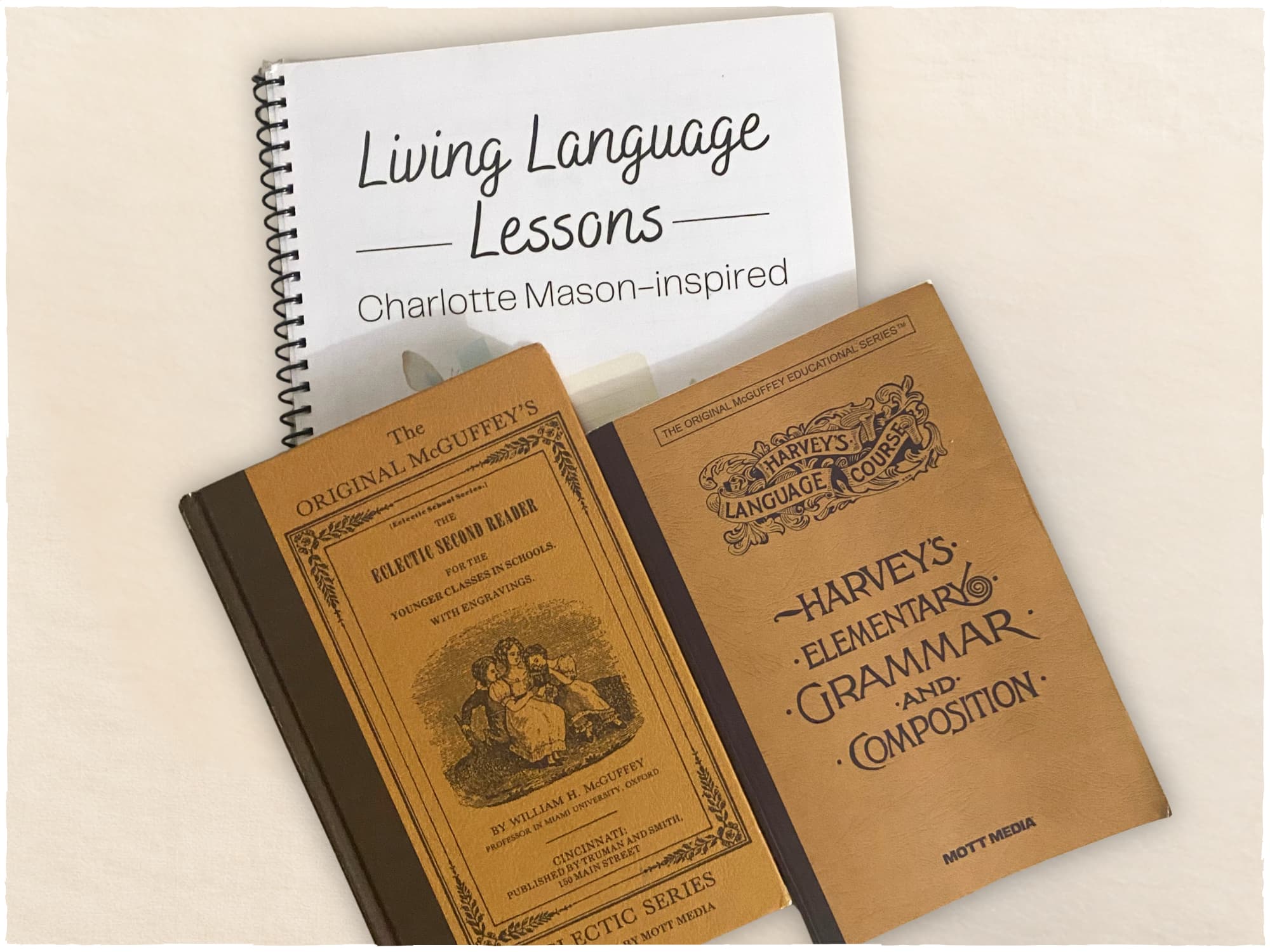
In our homeschool, grammar is something we explore throughout our language lessons, particularly during copywork and dictation. We use passages from our McGuffey Readers and other classic living books, often finding opportunities to discuss grammar as we’re reading together, too. I’ve shared more about how we use the McGuffey Readers in our homeschool if you’d like to explore them further.
As we work through a passage, we might talk about why an author used a particular punctuation mark, identify different parts of speech, or notice how the words are arranged to form a sentence. These discussions help my children understand grammar through the familiar language of their reading.
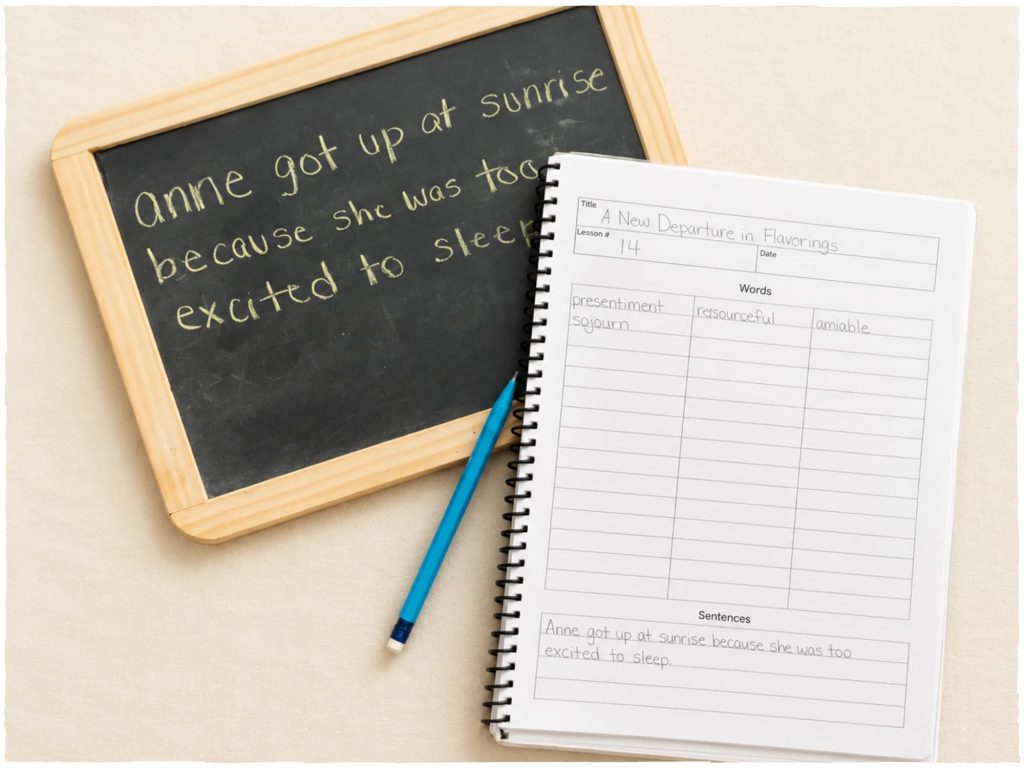
For additional practice, I’ll sometimes choose a sentence from one of their books, let them study it as it was originally written, and then remove the capitalization and punctuation for them to restore in their Living Language Lessons notebooks. If we’re working on a particular grammar concept, I might choose a sentence that gives us another example to look at together.
I like to keep these exercises short and purposeful, focusing on what each child is learning rather than filling pages with repetitive grammar work. Some of our best grammar lessons happen aloud, working through a sentence together before putting anything on paper.
A Simple Charlotte Mason Grammar Lesson
One of the best things about teaching grammar through living books is that you don’t need to prepare an elaborate lesson. A sentence from your child’s reading can give you plenty of opportunities to practice and review what they’ve been learning.
For example, let’s use this sentence from Anne of Green Gables by L. M. Montgomery:
Anne got up at sunrise because she was too excited to sleep.
1. Read and notice. Begin by reading the sentence together. Ask your child what they notice about the words and how the sentence is written.
2. Talk about the grammar. You might ask your child to find the proper noun Anne, identify the pronoun she, and look for the verbs in the sentence. You could also discuss how the word because connects two ideas and explains why Anne got up so early.
3. Practice what they’ve learned. After your child has studied the correctly written sentence, you might use it for a short notebook exercise on another day, removing its capital letter(s) and punctuation:
anne got up at sunrise because she was too excited to sleep
Have your child rewrite it correctly in their notebook. You might also choose a different sentence from their reading to practice a particular grammar concept, as well.
4. Review together. Look over their work and talk through anything they may have missed. This gives you an opportunity to see which concepts they’ve understood and which ones could use a little more practice.
You can easily adjust the lesson to suit your child’s age and understanding. Younger children might work on capitalization and punctuation, while older children can explore parts of speech and sentence structure in greater detail.
How I Know My Children Are Learning Grammar
One of the most encouraging things I’ve noticed in our homeschool is when my children begin recognizing grammar concepts outside of our lessons. Sometimes, while reading independently, they’ll come across something we’ve recently discussed and excitedly point it out to me.
Since much of our grammar work happens aloud and together, I also have plenty of opportunities to hear how well they’re understanding what we’re learning. We can talk through a sentence, identify different parts of speech, or discuss why a particular punctuation mark was used.
Their written work gives me another way to see how they’re progressing. When they can correctly punctuate a sentence, recognize a grammar concept in a new passage, or begin using what they’ve learned in their own writing, I can see that they’re beginning to understand and apply what they’ve learned.
If I notice a concept needs a little more practice, we can spend some extra time discussing it, find another example in our reading, and review it together before moving on.
What We Use to Teach Charlotte Mason Grammar
One of the things I appreciate about teaching grammar this way is that we can use many of the books and materials we already have in our homeschool. Our McGuffey Readers and other classic living books provide plenty of well-written passages to study, and we use our Living Language Lessons notebooks to keep our copywork, dictation, narration, and vocabulary work together.
I created these notebooks to make it easier to teach language arts through the books we’re already reading, with everything organized in one place.
While most of our grammar lessons come from these familiar books, we do occasionally turn to Harvey’s Grammar when we need a little extra help understanding a particular concept. My children find traditional grammar exercises a bit less enjoyable, so we tend to use it as a reference rather than something we work through regularly.
We also keep a dictionary close by and use it often during our language lessons. It’s especially helpful for looking up unfamiliar words, identifying parts of speech, and exploring the different ways a word can be used.
I’ve found that this combination works well for our family, giving us the freedom to learn through living books while having a few helpful references to turn to when needed.

Living Language Lessons
Bring your Charlotte Mason language lessons together with my Living Language Lessons notebooks. Designed to grow with your children, these printable notebooks give you an organized place for copywork, dictation, narration, and word study using the living books you’re already reading.
Explore Living Language Lessons →A Gentle Approach to Grammar in Your Homeschool
Over the years, I’ve come to appreciate just how much children can learn through good books, thoughtful discussions, and consistent lessons. I especially love seeing my children begin to recognize the grammar we’ve studied and apply it in their own reading and writing.
I hope these ideas encourage you to make grammar lessons your own, finding a rhythm that works well for your children and your family. With a few good books and a little time spent studying language together, you can give your children a wonderful foundation in grammar while continuing to enjoy the beauty of a Charlotte Mason education.


