
McGuffey Readers: Your Charlotte Mason Language Arts Guide

Over the years, McGuffey Readers have become such an important part of our Charlotte Mason language arts lessons. I’ve enjoyed using their stories and literary selections with my children for everything from vocabulary and copywork to dictation and narration.
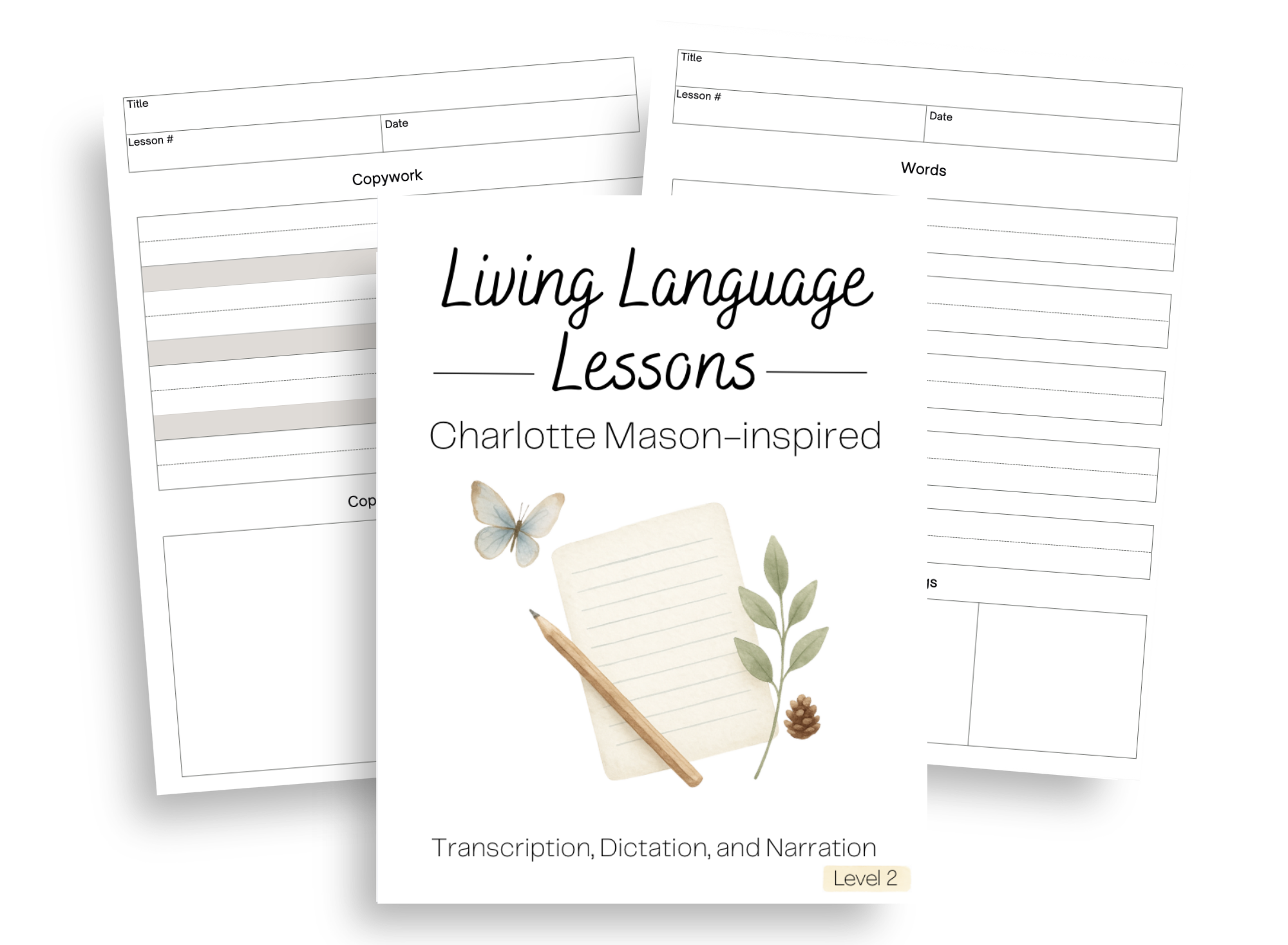
As I’ve taught more of my children, I’ve come to appreciate having a simple way to keep all of our language arts work together. That’s what led me to create Living Language Lessons, the notebooks we use alongside our McGuffey Readers and other favorite books.
I’d love to share how we use these notebooks in our daily lessons, how we approach the different areas of language arts, and a few ideas to help you get started in your own homeschool.
If you’re just getting acquainted with McGuffey Readers, you might also enjoy my guide to using McGuffey Readers in your homeschool, where I share which editions we use and how to choose a starting level.
This post may contain carefully chosen affiliate links to help support our homeschooling journey. Thank you for supporting my family through your purchases! You can read my full affiliate disclosure policy here.
Using McGuffey Readers for Charlotte Mason Language Arts
One of my favorite things about Charlotte Mason’s approach to language arts is how much we can do with a good book. A story or poem we’re already enjoying together can become the starting point for several different lessons.
That’s one of the reasons I’ve enjoyed using McGuffey Readers with my children. Their stories and literary selections give us plenty of opportunities to study language through the books we’re reading, from looking more closely at an unfamiliar word to noticing the way an author has written a sentence.
I appreciate being able to bring these lessons together through familiar readings, with our notebooks giving us a place to keep the written work organized.
How We Organize Our Charlotte Mason Language Arts Notebooks

With several children learning at different levels, I’ve found it helpful to have one place for their language arts work. We use our Living Language Lessons notebooks for this, but you can certainly begin with a simple notebook you already have at home.
Our lessons are built around four main areas: word study, copywork and transcription, prepared dictation, and narration. Here’s a closer look at how we use each one.
Word Study
When we come across an unfamiliar word in our McGuffey reading, we’ll stop to talk about what it means. Sometimes the meaning is clear from the passage, and other times we’ll pull out our dictionary and look it up together.
I like to have my children explain the meaning in their own words and then return to the original sentence to see how the author used it.
For the written portion of word study, my children typically record around 30 or so words from their reading in their notebooks for spelling practice. We don’t necessarily spend time discussing every word, but we’ll focus on a few of the more challenging or unfamiliar ones.
Copywork and Transcription
For my younger children, copywork begins with a few carefully chosen words or a short sentence. As they grow more comfortable with writing, we gradually move toward longer passages and transcription.
My older children often choose their own passages from their McGuffey Readers. I love giving them that opportunity because they begin to notice sentences and selections they especially enjoy.
During transcription, they pay attention to spelling, capitalization, and punctuation as they copy. We keep these lessons fairly short, focusing on careful, attentive work rather than filling a whole page.
Prepared Dictation
One of the simplest ways we’ve connected our language arts lessons is by using a passage for transcription one day and returning to part of that same passage for prepared dictation the next.
Before dictation, we look over any words that might be difficult and give the child time to study the spelling and punctuation. When they’re ready, I read the selected portion aloud for them to write without looking at the original.
Sometimes my older children even take turns dictating to one another, which is especially helpful on our busier homeschool mornings.
Narration
Narration is another important part of our language arts lessons, although not every narration needs to be written down.
My younger children tell back what they’ve read or heard in their own words. Sometimes they enjoy drawing something from the selection afterward.
As my children become ready for written narration, they can use their notebooks to record their thoughts about a story, poem, or other reading.
Having their work together in one notebook also makes it easier to see their progress over time, from those first short written narrations to more detailed and confident writing.
Our Four-Day Charlotte Mason Language Arts Schedule
We follow a simple four-day schedule for language arts, completing one page of our Living Language Lessons notebooks each day. Each activity has its own place in the week, which makes it easy to know what we’re working on next.
Here’s what a typical week looks like:
| Day | Language Arts Lesson |
|---|---|
| Day 1 | Word Study |
| Day 2 | Copywork or Transcription |
| Day 3 | Prepared Dictation |
| Day 4 | Narration |
Having those four lessons planned out has made it much easier to stay consistent with language arts. We’re not trying to fit everything into one day, and I don’t have to spend time deciding what comes next.
Of course, the actual work looks a little different depending on each child’s age and ability, but the basic routine stays the same. It’s a simple approach that’s worked well for us over the years.
Charlotte Mason Language Arts
Living Language Lessons
If you’d like to follow a similar language arts routine, my Living Language Lessons notebooks give you an organized place for word study, transcription, prepared dictation, and narration. The four-day layout makes it easy to move through your lessons while choosing passages from McGuffey Readers or other living books your children are reading.
Explore Living Language Lessons →How I Look for Progress in Language Arts

One thing I’ve appreciated about keeping our language arts work together is being able to see how my children’s skills develop over time.
I don’t give grades for our notebook lessons (or really any of our lessons). Instead, I pay attention to the little improvements that come with regular practice. A child who once struggled to copy a sentence carefully may begin noticing punctuation on their own. Words that were difficult during dictation become familiar, and written narrations gradually include more detail.
I also notice progress outside of their notebooks, especially when they use a new word in conversation or explain something they’ve read with greater understanding.
Of course, progress doesn’t always happen at the same pace. Some skills need more time and practice than others. Being able to look back at their work helps me see where they’re growing and where we might need to spend a little more time.
Bringing Your Charlotte Mason Language Arts Lessons Together

If you’re hoping to use McGuffey Readers for more of your language arts lessons, I’d encourage you to begin with a simple four-day routine. As you become familiar with the routine, you’ll get a better feel for how much writing to expect, which passages to choose, and where your child may need a little extra practice.
I hope sharing how we use McGuffey Readers alongside our Living Language Lessons notebooks gives you a helpful starting point for your own Charlotte Mason language arts lessons.




The download here passage doesn’t seem to have a link attached.
Thank you sop much for letting me know. ❤️ The notebooks available here.